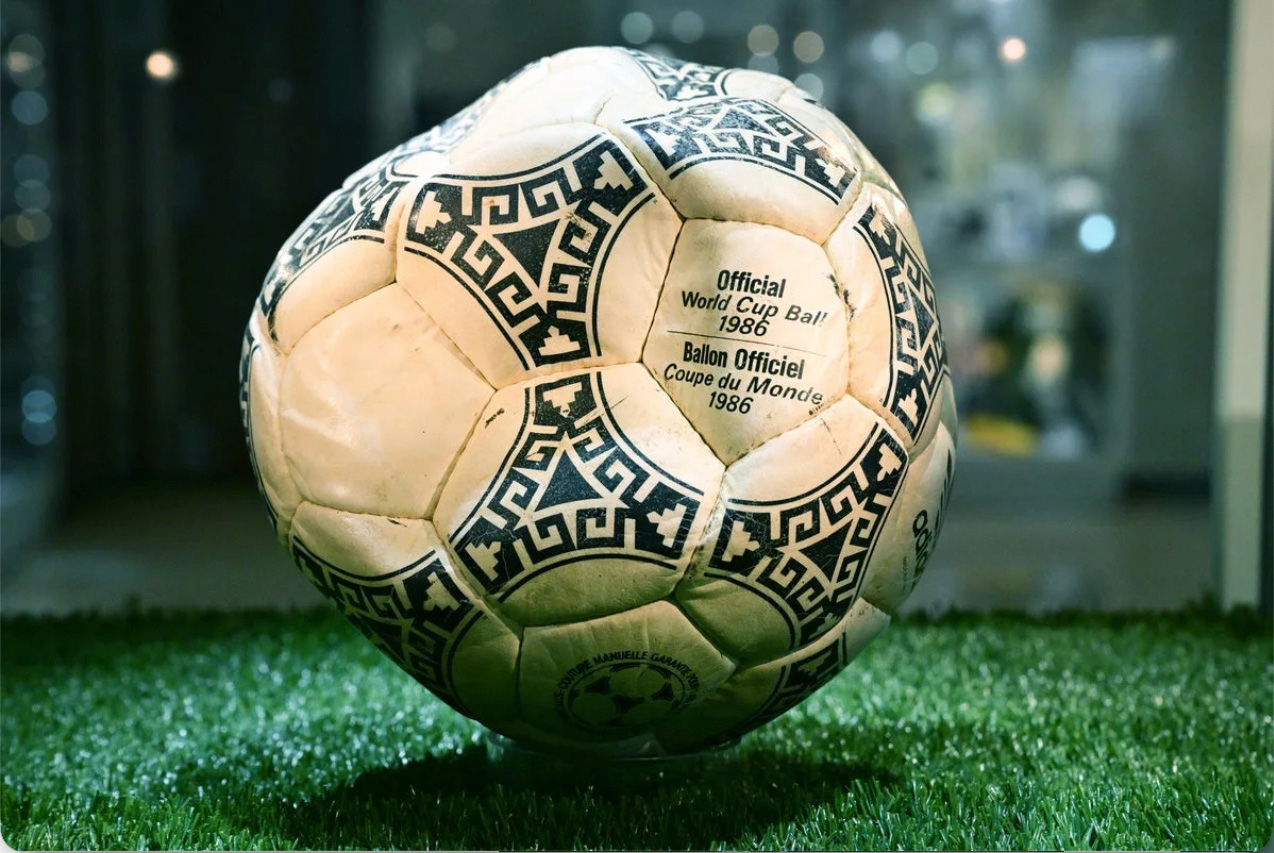
Scrolling through my news feed the other day, my attention was drawn to a headline concerning a football fetching £2.5 million at an auction. I touched the link, and a photo appeared of a rather sad, misshapen, looking football, which incongruously was being held aloft for inspection by a pair of white gloved hands. It’s been a while since I bought a football, I know with inflation and branding they not as cheap as they used to be, but even so by my rough calculation I could buy at least 60,000 balls for the price of this one. What’s so special about it?
As I read on, it turns out that the seller must have felt the same sense of deflation their ball was showing, because the auction house expected it to sell for closer to £10 million. Still, they did make a million off the ball in the four years they owned it, so not too bad. However, it’s not the ball itself which has intrinsic value, although it was a top-quality football for its day, but rather it is where it was used, and in particular, who touched it, and with what. I have never touched this ball myself, but in a funny way it has touched my life, indeed I have seen it in person, watched it being kicked, followed its trajectory, and witnessed the fateful hand which propelled this ball into history.
Who doesn’t want the hand of fate to touch their stories and nudge them into the realm of immortality? But when the final full stop is placed will they retain the value we desire? Whose touch can do that?

The story of my association with this ball begins in a pub in Charing Cross, London, just before Christmas 1985. I was there to meet a couple of mates who I hadn’t seen for a while. I went to horticultural college with Pete, and then afterwards we both worked on a nursery near Portland Oregon, which is where we met the other friend, Brian. Brian was over in England visiting friends and relatives, so we arranged to meet in London. After returning from America, I had started a small nursery growing miniature roses, but I lived in a rural area and was a bit isolated. I missed my previous social life, so I looked forward to a day in London with friends.
I caught an early morning train and emerged into one of those cold, grey, damp, unmistakably London days, in which even the warmest coast is infiltrated. A pigeon flapped stiffly on a railing, a chestnut roaster was warming his hands over the coals of his barrel, the sweet aroma of the nuts mingled with the diesel incense of passing traffic. I found the pub we arranged to meet in, entered, and was greeted by some tinsel and tiny lights wound around a scrawny Christmas tree. Scanning the room, I spotted Brian and Pete at a table, and after collecting a pint I went over to join them. We chatted away, catching up with our lives, our loves (or lack of them), wins, our loses, and of course we talked about sport, especially football. Several hours and pints later the conversation returned to football, not that it had ever strayed far away. “You know the World Cup is in Mexico next year,” said Brian. Pete and I nodded, yes of course we knew, “we should go. You and Pete could come to Portland and then we could travel down to Mexico and follow England.”
I wouldn’t say it had been a full-blown dream of mine to go to a world cup, but it certainly had been at least a seed for a long time, sown by a schoolteacher who went to the 1970 world cup in Mexico. Sometimes in class he regaled us with his stories, encouraging us to go out and explore the world for ourselves. As much as I might have wanted to go, the idea was of course impossible. “There is no way I can go. I don’t have anyone else to look after my nursery, June is one of the busiest months, I can’t just take off for a month.” I expected Pete to also decline for similar commitments, but to my surprise he jumped at Brian’s invitation. “Yes, I’m up for it, let’s go.”
There was no social media back then of course, so I didn’t have to worry about seeing the feeds of them having the time of their lives while I was stuck back home alone with my roses, but what if one of those “wish you were here” postcards dropped through my letter box? What if when I was watching a game on the telly I spotted them in the crowd having the time of their lives? How would I feel? The fear of missing out loomed large in my mind, but not enough to push me into acceptance. A sense of responsibility kept my resolve. Brian and Peter talked excitedly between themselves, outlining a rough plan of execution, while I listened to Whitney Houston on the juke box for the umpteenth time singing about how she was “Saving all her love.” Who kept putting that song on? “It’s not easy living alone,” she sung, and I had to agree.
Brian needed to do some Christmas shopping before flying out the next morning, so we emerged into the gathering gloom of late afternoon. London was in festive mood, as indeed were we, bundled shoppers on mission filled the pavements, while strung above bright angels looked down on the throng with indifference.
A couple of hours later, Brian’s shopping objectives accomplished, we sat in another pub, warming ourselves. Of course, the Mexico conversation had not gone away, and my two friends weren’t willing to let me escape their grasp either. “Come on Bry, you can’t miss out on this, it’s a once in a lifetime opportunity to go and see the world cup. You have to come; it will be great.” I remembered the last time I succumbed to a, “come on mate, it will be great” invitation, was when Pete persuaded me (again after a few pints) to join him and some others from college to go parachuting. I hate heights, yet a few weeks later found myself jumping out of a perfectly good aeroplane! I felt my defences weakening, like a sandcastle facing the incoming tide, the end is inevitable. I inhaled deeply from my cigarette, holding it for a few seconds before exhaling the smoke and my final grains of resistance; “alright, I will go.” We celebrated the rest of the evening as if England had already won the world cup.
The next morning, gazing out of the train window, I watched the London suburbs slowly give way to bare hedges and worn fields, I mulled over the previous night. Of course, the whole idea was preposterous, I was fairly sure we would forget all about it once we got home to the routine of our lives, and in future get togethers would reminisce about how we nearly went to the world cup. Still, inside I felt the seed germinating, roots pushing out to give the idea support, a green shoot was emerging about the surface to give it light, and against the run of play an unexpected hand was nudging me in a new direction.

I dropped onto the bed, laid there with the demarcation between reality and fantasy a blur. Were those actual or imaginary cockroaches scuttling along the skirting board? Montezuma was exacting his revenge, although I was at a loss to know what precisely I had done for him to be quite so vindictive. Nevertheless, regardless of my professed innocence, my stomach had been in his firing line almost since day one of me arriving in Monterrey Mexico for England’s first game. I think he might have been in the ice! I did my best to expel him. First, I tried starving him out by fasting for a few days, but that failed to shift him, so I attempted to drown him in Dos Equis and Tequila, but still to no avail. He would not budge. For over three weeks I had been unable to keep anything I ate in me for more than about ten minutes, so consequently by the time we arrived in Mexico City the night before the England v Argentina game I was in bad shape, although looking back I don’t think I realised just quite how serious my condition was. I kept thinking it would go away eventually, but I was the one in danger of going away. The city was in uproar; Mexico had just lost to Germany on penalties and was at a standstill. Eventually we found our hotel, a rather run down and dilapidated building, but it only cost us $4.00 a night so we could hardly complain. As I lay on the bed, I thought it was going to be curtains. A rather ignominious way to go, but it was my fault. If I had just stuck to my guns, and stayed home like Brian, I wouldn’t be here lying here at death’s door. There is perhaps nothing quite so lonely as being seriously ill, stuck in a crumby hotel, thousands of miles from home. Was life really so bad before? Why hadn’t I stuck to my guns and refused to be pushed in to coming here?
I am not sure how long I lay there hallucinating that night, but after what must have been many hours of delirium, I awoke to find a strange man peering over me. I still don’t know to this day where Pete found him, but he was a doctor, or at least he said he was, and he was here to save me. He produced a syringe out of his bag to which he attached a large needle, filled it with some opaque liquid, which he then injected into my backside. He handed me a bottle of pills and gave me instructions on what to eat and drink for my recovery. The next morning, I awoke to find the fever gone, and I was compos mentis again. I was back from the dead! There was just one question on my mind? Was I strong enough to make the game? Although it took me six weeks to fully recover, I was able to make it to the Azteca Stadium that day, with 115,000 others to witness the hand of fate.

Peter Shilton heading home
The game is now part of footballing history, mostly because of one man, Diego Maradona who scored two goals; “the goal of the century,” and the “hand of God.” “A little with the head of Maradona, and a little with the hand of God” was how he described the goal immediately after the game. Some years later he admitted in his autobiography that God’s hand had nothing to do with the goal whatsoever. “Now I can say what I couldn’t say at that moment, what I defined at that time as the Hand of God. What hand of God? It was the hand of Diego!”[i]
I was gutted England lost, especially the way we lost, but on the other hand I was quite glad to be leaving behind Montezuma in Mexico. It is funny how different hands can change the course of our lives. For Maradona his hand became synonymous with that game, he was both genius and villain rolled into one. He went onto fame and fortune, but by all accounts, lived a sad and troubled life. Although he admitted the handball, he never apologised for it. The referee on the day was Tunisian Ben Nasser, he took credit for keeping the whistle in his hand out of his mouth, allowing Maradona to score his “second” wonder goal. However, he refused to take the blame for his decision to allow the “hand of God” goal to stand. He faulted the linesman. Nasser kept the match ball for 36 years before selling it for £1.2 million. Who says making the wrong decision doesn’t pay? The Bulgarian linesman Bogdan Dochev blamed Maradona, “Diego Maradona ruined my life. He is a brilliant footballer but a small man. He is low in height and as a person.” Bobby Robson, the England manager was also in no doubt, “It wasn’t the hand of God, it was the hand of a rascal. God had nothing to do with it.”
Was it nothing to do with God? Is God’s hand only present when we play by the rules? How much in life is God’s hand, and how much are our own hands? How can we tell whose is whose? Do we ever admit that perhaps it was rather more our hand than God’s? Do we ever apologise when we haven’t played by the rules, when we succumb to the temptation to give the ball a nudge because we are so desperate to win the game of life. It’s hard to leave the result to God, so we hope no one notices when we slip in a surreptitious touch, especially God, and we don’t get penalised. We excuse ourselves by claiming we have mostly played by the rules, yes, there might be a few questionable touches, but generally speaking our good outweighs those times, so we deserve to win.

My view of the Game
I never went back to England to live after the game. Instead, I settled in Oregon, I found everything I hoped for; home, family, employment, and social life. I congratulated myself on what my hand had earned for me; I had made it. Or had I? The hand of fate gives, and the hand of fate takes away, all that our hands ever achieve is tenuous at best. It only takes a touch from Montezuma or one of his mates for life to change in an instant from overflowing and satisfying, to hollow and depleting. Even if we make it all the way to the end with everything we have touched intact, futility beckons; a fate our hands cannot change.
But while our hands cannot change this fate, there are hands which can, nail scared hands, hands which were stretched out and fastened to a cross. It seems bonkers to place our lives in those hands, after all how can they save anything? The people who hung Him on the cross thought the same thing. They were tired of his hands touching what He wasn’t supposed to, they were upset with Him not playing by their rules, and they were angry with Him claiming His touch was the hand of God. They thought the game was won; their opponent was dead and buried. His memory will soon fade, His hands will never be seen again, and they will never again have to worry about his touch.
In two thousand years time I wonder what the “hand of God” ball will be worth? Will any part of it still exist? Will anyone even know, let alone care about what happened on a football pitch in Mexico in 1986, and how the “unseen” touch of a man’s hand won a game.
Two thousand years after Jesus was “dead and buried” His hands are still touching lives, because He broke the rule of death, and is able to hand the same victory to anyone who puts their faith in Him, regardless of what their own touch has brought them. His story becomes our story.
Forty years on and ten world cups later I am still left hoping I will live long enough to see England’s fate change against Argentina, but maybe that is a forlorn hope. My body is not as taut as it was, parts of it look a little worn, and I don’t want it held up for close inspection. It is depreciating by the day! But I know my value doesn’t lie in my hands, it lies in Jesus’ hands whose touch gives me immeasurable, eternal worth. When the final full stop of my story is placed, I know “Whose hand” can be trusted.

Post Montezuma, 18lbs lighter!
[i]. Yo soy el Diego, autobiography of Diego Armando Maradona. Editorial Planeta, 2000, p. 32. ISBN 84-08-03674-2.
Discover more from The Reflective Life
Subscribe to get the latest posts sent to your email.